


MRI Quench Vent Systems: Design & Safety
Understanding the MRI Quench Process
MRI systems use liquid helium to maintain the extremely low temperatures required to operate their superconducting magnets. During a magnet quench or emergency shutdown, the liquid helium rapidly changes from a liquid to a gas, creating a tremendous volume of expanding gas that must be safely directed away from the MRI system.
The quench vent system provides the controlled path for this gas, carrying it from the magnet through the vent piping to a designated exterior discharge point.
Designed for Rapid Expansion and Extreme Temperatures
A properly designed MRI quench vent system must accommodate both the rapid expansion of helium gas and the extreme temperature change that occurs during a quench. Liquid helium is approximately -452°F (-269°C), and the transition from liquid to gas can produce an expansion of approximately 700:1.
These conditions create significant demands on the vent system. Proper sizing, routing, material selection, support, and pressure-drop considerations are critical to the safe and reliable operation of the MRI system.
Materials & Thermal Movement
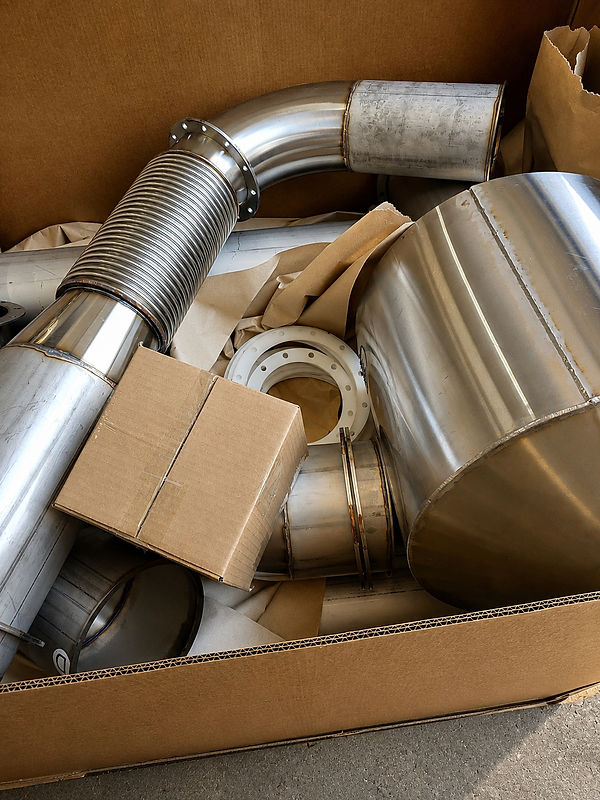
MRI quench vent exhaust assemblies are constructed from non-magnetic stainless steel, commonly 304 stainless steel, to meet the requirements of the MRI environment.
Because the vent system is exposed to extreme temperature changes during a quench, the design must account for thermal expansion and contraction. Stainless steel bellows and flexible sections may be incorporated where required to accommodate thermal movement while maintaining system integrity.
Proper support and guide placement are also essential. The vent system must be securely supported by the building structure while allowing for the movement associated with thermal expansion and contraction.
Engineering & System Performance
Every quench vent installation has its own requirements based on the MRI system, vent configuration, building layout, and discharge location. Proper engineering calculations help determine the appropriate vent configuration and verify system performance, including pressure-drop requirements.
At Ernie’s Welding & Fabricating, we work directly with MRI manufacturers and installation requirements to manufacture quench vent systems and components designed for the specific application.
From the MRI connection to the exterior termination, Ernie’s builds quench vent systems with the materials, fabrication quality, and precision required for this critical safety application.
MRI Quench Vent Systems
An MRI quench vent system is a critical life safety system designed to safely discharge helium gas outside the building during an emergency magnet quench. Proper engineering, fabrication, and installation are essential to protect patients, staff, equipment, and the MRI suite.
Since 1972, Ernie’s Welding & Fabricating has been manufacturing custom stainless steel MRI quench vent systems for hospitals, imaging centers, contractors, and OEMs worldwide.
Why MRI Quench Vent Systems Matter

MRI magnets operate using liquid helium to maintain superconducting temperatures. If the magnet loses superconductivity, the helium rapidly expands from a liquid into a large volume of extremely cold gas.
A properly designed quench vent system safely directs that gas outdoors.
Without a correctly engineered vent system, helium can enter the MRI room, displacing oxygen and creating a serious asphyxiation hazard. Improper venting can also damage expensive imaging equipment and building infrastructure.
Our systems are designed to deliver unrestricted airflow while accommodating thermal expansion, contraction, and the demanding conditions of an MRI quench.
Engineered for Reliable Installation
Our in-house engineering and CAD team works directly with contractors, architects, and MRI manufacturers throughout the design process.
By reviewing routing, clearances, support locations, and connection details before fabrication begins, we help eliminate installation issues and reduce costly field modifications.
Each component is manufactured for an accurate fit, allowing installation crews to assemble the system efficiently with confidence.


